
The alpaca is a small, long-necked, densely fleeced camelid from the South American highlands. It walks on soft padded toes rather than hooves, hums quietly to its herd, lives for two decades, and produces one of the finest natural fibers in the world. It is not a llama. It is not a sheep. It is not, as tourists sometimes decide, a large poodle. The alpaca is its own animal, shaped by thousands of years of deliberate selection at altitudes most domestic species cannot tolerate.

What an alpaca is
Scientifically, the alpaca is Vicugna pacos — a member of the family Camelidae, the same family that includes the camels of Africa and Asia. In South America the family is represented by four species: two wild (the vicuña and the guanaco) and two domestic (the alpaca and the llama). The alpaca is the smallest of the four and the only one bred primarily for fiber.
An adult stands 81 to 99 cm (32 to 39 inches) at the shoulder and weighs between 55 and 82 kg (120 to 180 lb). It has a long neck, an upright posture, a short tail, and a characteristically blunt, blocky head — a feature that distinguishes it immediately from the longer-faced llama. Its feet end in two padded toes with a soft leathery sole, which is why alpacas walking across a pasture cause almost no compaction or damage.
Almost everything else about the animal — its fleece, its color range, its behavior, its eating habits — is a direct consequence of where it evolved: the high, dry, cold, thin-aired grasslands of the Andes between 3,500 and 5,000 metres above sea level.
Taxonomy and close cousins
For most of the twentieth century the alpaca was classified as Lama pacos, implying a descent from the llama. Genetic work completed in the early 2000s overturned this. Mitochondrial DNA analysis demonstrated that the alpaca descends primarily from the vicuña (Vicugna vicugna), not from the llama. The classification was formally updated, and the alpaca is now Vicugna pacos.
The llama, meanwhile, is the domestic descendant of the guanaco (Lama guanicoe). So within the four South American camelids there are two evolutionary lineages: vicuña → alpaca (a fiber line) and guanaco → llama (a pack-animal line). In practice, the four species can and do interbreed, producing a range of hybrids that have blurred genetic lines for centuries.
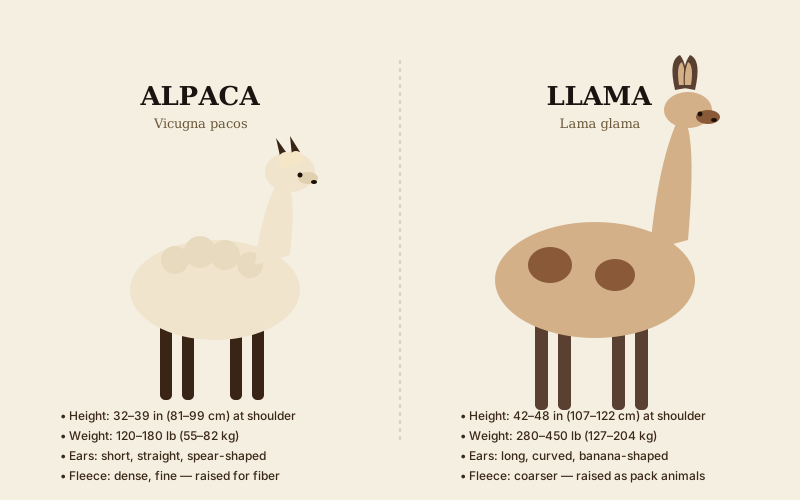
Quick distinguisher
Llama ears are long and curved — "banana-shaped." Alpaca ears are short and straight — "spear-shaped." Llamas are roughly twice the weight of alpacas and were bred as pack animals. Alpacas were bred for one thing: fleece.
A 6,000-year history with Andean peoples
Archaeological evidence from sites in the Puna de Junín (central Peru) places alpaca domestication at roughly 6,000 to 7,000 years ago, long before the Inca. The process took place in the Andean altiplano, probably beginning with the selective hunting and then captive breeding of vicuña populations. By the height of the Inca Empire in the fifteenth century, alpaca and llama herds ran into the millions, managed by state herders on behalf of the Sapa Inca, the nobility, and the temples.
Under Inca rule, fine alpaca cloth — cumbi — was the most valuable textile in the empire. It was woven in state workshops, sometimes from fleeces selected a single strand at a time, and was used as tribute, as a diplomatic gift, and as burial cloth for the highest-ranking dead. Spanish chroniclers arriving in the 1530s described cumbi as finer than anything produced in Europe at the time.
The Spanish conquest was catastrophic for alpaca populations. Introduced European sheep and cattle displaced native herds; selective breeding programs collapsed; and disease and neglect wiped out something in the order of 90 percent of the national herd within a century. The genetic quality of the animal suffered a loss it is arguably still recovering from. Only because alpacas persisted in the hands of indigenous communities at very high altitudes — zones the Spanish found unpleasant and unprofitable — did the species survive at all.
In the twentieth century, Peruvian governments began to formalize breeding, fiber grading, and export. Today alpaca fiber is once again a recognized luxury product, and herds have slowly recovered to an estimated 3.5 to 4 million animals nationwide.
Anatomy
The alpaca is built for the altiplano. Several features reflect that adaptation.
Respiratory system
Alpacas, like all camelids, have elliptical red blood cells with a high oxygen-carrying capacity and a hemoglobin variant that releases oxygen efficiently in the low-pressure atmosphere of high elevation. They thrive at 4,000 m where most large domestic mammals would struggle.
Feet
The alpaca foot has two toes, each tipped with a hard nail, and a soft leathery sole. This is radically different from a hoof. The result is a very low-impact animal — pastures grazed by alpacas show far less compaction and trail damage than those grazed by sheep or cattle.
Teeth
Alpacas have a dental pad on the upper jaw (no incisors in front) and sharp lower incisors that work against it. This gives them a neat bite that clips grass rather than tearing it out by the roots — another reason they are easier on pasture than sheep. They also have molars for grinding, and adult males develop fighting teeth: three sharp canines on each side, which are routinely blunted by keepers to prevent injury during dominance disputes.
Stomach
Alpacas are modified ruminants. They have a three-chambered stomach (not four, like true ruminants such as cattle and sheep). They chew cud, ferment plant matter in the first two chambers, and are capable of extracting nutrition from rougher forage than most domesticated species. They drink surprisingly little water, another legacy of camelid physiology.
Fleece
The defining anatomical feature. Alpaca fleece covers the body, neck, legs, and belly, leaving the face and the lower limbs bare. It grows continuously and is sheared once a year, typically yielding 2 to 5 kg per animal. The fiber itself is covered in its own dedicated chapter.
Behavior and temperament
Alpacas are herd animals. An alpaca kept alone becomes stressed; the minimum recommended group size is three. Within a herd they establish a loose hierarchy, communicate mostly through body posture and a soft humming sound, and spend the majority of their waking hours grazing.
They are generally gentle and curious but not demonstrative. Alpacas are not affectionate in the way dogs or horses are — most do not enjoy being stroked on the head or face. They tolerate humans in proportion to how they were handled as crias (babies). Well-socialized alpacas can be led on halter, trained for trekking, and worked with calmly. Poorly socialized ones remain flighty for life.
Spitting
The reputation is exaggerated. Alpacas spit — projecting stomach contents rather than saliva — but almost exclusively at other alpacas, and almost exclusively in disputes over food, personal space, or reproductive access. Spitting at humans is rare and usually a sign that the animal has been badly handled or cornered. A well-managed alpaca may go its entire life without spitting at a person.
Vocalizations
The most common sound is a soft, almost meditative humming. Mothers hum to their crias; crias hum back; anxious or separated animals hum more loudly. Alarm calls are a high-pitched, warbling shriek reserved for genuine threats — usually dogs or unfamiliar humans appearing suddenly. Males make a throaty, gurgling call called orgling during mating.
Communal dung piles
One of the alpaca's most remarkable behaviors is its use of shared dung piles. A herd will select one or several specific spots in a pasture and deposit droppings only there. The rest of the field remains clean. This habit simplifies hygiene, reduces parasite spread, and has been exploited for centuries — alpaca dung is a prized fertilizer and, dried, a traditional highland fuel.
Lifespan
A healthy alpaca lives 15 to 20 years, with occasional individuals reaching 25. Females can remain reproductive until 12 to 15 years of age, though most breeders retire them earlier. The main causes of premature death in farmed herds are parasites (particularly in wet climates outside the Andean home range), predation, and complications of birth.
Where alpacas live today
About 87 percent of the world's alpacas live in Peru — around 3.5 to 4 million animals, concentrated in Puno, Cusco, Arequipa, Huancavelica, and Ayacucho. Bolivia holds the second-largest national herd, followed by Chile, Ecuador, and Argentina. Outside South America, alpacas have been introduced as fiber and hobby livestock in Australia, the United States, the United Kingdom, New Zealand, Canada, and parts of continental Europe, though the genetic base of these populations is narrow and the animals rarely match the fiber quality of the Andean homeland.
For a closer look at the region where most of the world's alpaca fiber still originates, see our chapter on Cusco and the alpaca country of southern Peru.
Next chapter: The Two Breeds — Huacaya and Suri.