
The complete guide to the alpaca.
Biology, breeds, the softest natural fiber on earth, husbandry, health, and the handwoven garments that carry it all into the world. Written from the heart of the Andes.
A 6,000-year-old relationship between people and a gentle Andean animal.
The alpaca (Vicugna pacos) is a domesticated camelid native to the high plateaus of Peru, Bolivia, Chile, and Ecuador. It was bred by pre-Inca civilizations not for meat or labor, but for one thing: its extraordinary fleece.
Smaller and more delicate than its cousin the llama, the alpaca stands about 90 cm at the shoulder and rarely weighs more than 80 kg. It is a herd animal, soft-footed, surprisingly quiet, and — contrary to its reputation — a spitter only under genuine stress. What makes it remarkable is not behavior but biology: a coat that grows in more natural shades than any other fleece-bearing animal, in fibers hollow at the core, free of lanolin, and so fine that the best of them rival cashmere.
Today roughly 87% of the world's alpacas live in Peru, most of them in the departments of Puno, Cusco, Arequipa, and Huancavelica, at altitudes where little else can be farmed. This site is a complete, open reference to the animal, its fiber, and the products made from it — written for farmers, knitters, buyers, scientists, and the simply curious.
Nine chapters on one animal.
Every topic below is an in-depth article. Start anywhere — each chapter stands alone, and every page links back to the rest.
About the Alpaca
Origins, taxonomy, domestication, anatomy, and the long relationship between alpacas and Andean peoples.
Read → CHAPTER IIThe Two Breeds
Huacaya and Suri — how to tell them apart, why one has dense fluff and the other silky locks, and what to look for.
Read → CHAPTER IIIAlpaca Fiber
The microscopic structure behind the softness, the grading system, the 22 natural colors, and why it outperforms wool.
Read → CHAPTER IVHusbandry & Diet
Herd behavior, pasture needs, shelter, fencing, shearing, and the feeding calendar through a Peruvian year.
Read → CHAPTER VHealth & Medicine
Common conditions, parasites, vaccination schedules, body-condition scoring, and when to call the vet.
Read → CHAPTER VIReproduction
Induced ovulation, mating behavior, the 11-month gestation, birthing the cria, and the first hours of life.
Read → CHAPTER VIIGenetics & Color
Why color inheritance in alpacas is uniquely complex, the MC1R and ASIP loci, and what breeders need to know.
Read → CHAPTER VIIIProducts & Textiles
From raw fleece to finished garments: ponchos, scarves, sweaters, blankets, and the artisans who weave them.
Read → CHAPTER IXFrom Cusco to the World
Why Cusco is the heart of alpaca country, how we source and ship, and what makes Peruvian alpaca the gold standard.
Read →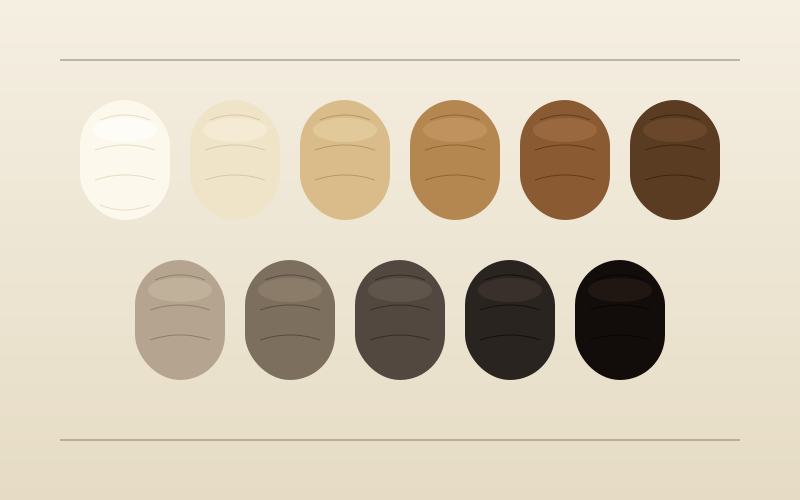
No dye. Twenty-two colors.
Most fleece-bearing animals produce fiber in a handful of shades. Alpacas produce it in a spectrum: pure white, ivory, champagne, fawn, light brown, red-brown, dark brown, silver grey, rose grey, dark grey, and jet black — plus every blend in between.
That range is not a branding story. It is the result of two pigment loci (MC1R and ASIP) interacting in ways that, even now, genetics laboratories are still mapping. For the weaver, it means natural garments with no dye bath, no synthetic fixatives, and no fading. For the farmer, it means color-breeding is a complicated, rewarding game.
Looking for alpaca products?
We ship handcrafted alpaca garments worldwide from Cusco — ponchos, scarves, sweaters, blankets, and exclusive pieces not available online. The full catalog is shared by email on request.
[email protected]Write to us in English or Spanish. We reply within one business day.