
Alpaca fiber is the reason the species exists in its current form. Everything about the animal — its altitude tolerance, its placid temperament, its 6,000 years of domestication — is in one way or another a consequence of selection for the stuff that grows out of its skin. This chapter explains what that fiber actually is, how it is measured, how it is graded, and why a sweater knit from it behaves so differently from one knit from sheep wool.
What makes alpaca fiber special
Five things, roughly in order of commercial importance:
- Softness. Fine alpaca fiber measures between 15 and 22 microns. Cashmere is typically 14 to 16. Merino wool, the softest sheep wool commonly available, runs 17 to 24. Alpaca fiber at its best competes directly with cashmere, and it does so from an animal that yields ten times as much fleece per shearing.
- Warmth. Alpaca fibers are hollow or contain medullated air pockets along the core. Air is an excellent insulator. Weight for weight, alpaca garments are warmer than sheep wool garments by an estimated 30 percent.
- Lack of lanolin. Sheep produce lanolin, a waxy grease that waterproofs the fleece on the animal and triggers allergies in some humans. Alpacas produce no lanolin. Their fleece requires no chemical scouring, which preserves fiber quality during processing, and the absence of lanolin makes alpaca garments dramatically less allergenic.
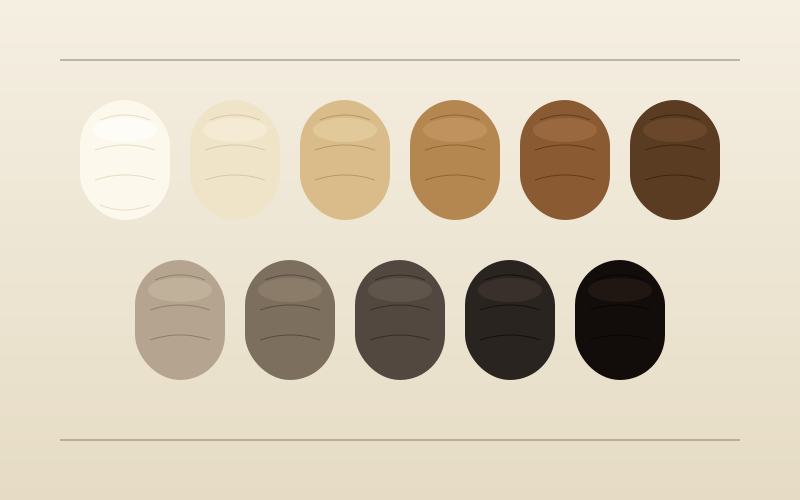
- Color range. Alpaca fleece is produced naturally in 22 official shades ranging from pure white through ivory, champagne, fawn, russet, brown, grey, and black. Few other fiber animals produce usable non-white fleece at all, let alone this range.
- Strength. Alpaca fiber is roughly three times stronger than sheep wool of equivalent fineness. Garments hold up over decades. A well-made alpaca poncho can be handed down two or three generations.
Microstructure — the hollow core
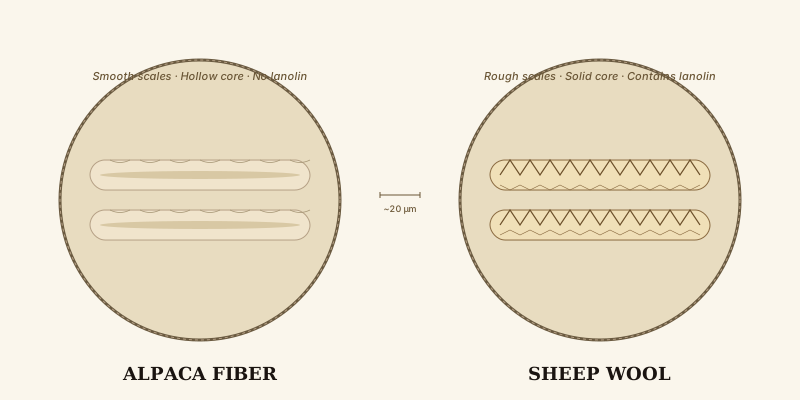
Every mammalian hair — whether on a human, a sheep, or an alpaca — consists of three zones: an outer cuticle of overlapping scales, an inner cortex of spindle-shaped cells, and, optionally, a central medulla. The differences between species live in the details.
The cuticle
The cuticular scales on alpaca fiber are smaller, shorter, and lie flatter against the shaft than those on sheep wool. Fewer and less pronounced scales mean less friction against skin, which is most of what "softness" actually measures. It also means alpaca fiber is less prone to felting under normal wear — a real advantage for everyday garments, though it complicates deliberate felting for craft use.
The medulla
In alpaca fiber, the medulla is either completely hollow or a string of air-filled vacuoles running down the core. Sheep wool fibers are generally solid through the middle, or have only a small, discontinuous medulla. This is the biggest single reason alpaca is warmer per gram than wool: the fiber is literally full of insulating air.
No lanolin
Unlike sheep, alpacas do not secrete lanolin from their skin. The raw fleece arrives at the mill clean enough that in many cases a cold-water rinse is sufficient before carding. By contrast, raw sheep wool may lose 40 to 50 percent of its weight in chemical scouring alone. The absence of lanolin makes alpaca processing cheaper, greener, and — critically — preserves the natural softness that aggressive scouring would degrade.
The grading system
Alpaca fleece is graded by average fiber diameter, measured in micrometres (microns, μm). The finer the fiber, the softer and more valuable it is. Commercial grading systems vary slightly by country and mill, but the Peruvian standard — which is the global reference — defines six grades.
| Grade | Average fineness | Typical use |
|---|---|---|
| Royal Alpaca | < 19 μm | Luxury woven garments, scarves, stoles, suiting fabric. The rarest grade. |
| Baby Alpaca | 19.0 – 22.5 μm | Fine knitwear, shawls, infant garments. The highest-volume luxury grade. |
| Superfine (fleece) | 22.6 – 25.5 μm | Quality knitwear, sweaters, cardigans. |
| Huarizo | 25.6 – 29.0 μm | Warm outerwear, blankets, heavier knits. |
| Coarse | 29.1 – 32.0 μm | Rugs, carpeting, industrial textiles. |
| Mixed Pieces | > 32 μm | Padding, stuffing, felt bases. |
Two points tend to confuse buyers. First, "Baby Alpaca" does not come from a baby animal — it is a grade, not an age. Most Baby Alpaca fiber comes from a single particularly fine patch of the adult fleece called the blanket, which covers the back and upper sides of the animal and produces the best fiber on the body. Second, within a single animal's fleece, different zones grade differently: the blanket is always finest, the neck and britch (rear legs) are always coarser. Sorters separate these zones during skirting — the first step of fleece preparation.
Alpaca vs sheep wool
| Property | Alpaca fiber | Sheep wool |
|---|---|---|
| Softest commercial grade | ~15 μm (Royal) | ~17 μm (Merino) |
| Fiber core | Hollow / medullated | Solid or small medulla |
| Lanolin | None | 10–25% by raw weight |
| Warmth (vs weight) | ~30% warmer | Baseline |
| Tensile strength | ~3× wool | Baseline |
| Hypoallergenic | Yes (no lanolin) | No |
| Natural color range | 22 shades | Mostly white, some black/brown |
| Felting tendency | Low | High |
| Wrinkle recovery | Excellent | Good |
The one area where sheep wool outperforms alpaca is elasticity — Merino in particular has a very lively crimp that springs back aggressively from compression. This is why Merino dominates in fitted athletic base layers and in technical knitwear where stretch-and-recovery matters. For everything else — warmth, softness, durability, hypoallergenic properties, color — alpaca is the stronger fiber.
Alpaca vs cashmere
Cashmere — fiber from the undercoat of the cashmere goat — is the benchmark against which luxury alpaca is measured. On fineness alone, top cashmere (14 to 16 microns) edges out even Royal Alpaca. But the comparison becomes more interesting when you widen the frame.
- Yield per animal. A cashmere goat produces roughly 150 grams of usable undercoat per year. A fiber alpaca produces 2.5 to 5 kilograms — a 15 to 30× difference.
- Durability. Cashmere is notorious for pilling and for developing holes after only a few seasons. Alpaca fiber is considerably stronger and holds up dramatically better over time.
- Warmth. Alpaca's hollow core gives it a warmth-per-gram advantage even over cashmere.
- Environmental footprint. Cashmere goats graze aggressively, pulling grass out by the roots and contributing to pasture degradation in Mongolia and China. Alpacas clip grass neatly with soft-padded feet and a dental pad, with minimal pasture damage.
The honest summary: cashmere will still feel marginally softer on first contact. Alpaca will still feel warm and excellent on the thousandth wear.
The 22 natural colors
No other fiber animal approaches the alpaca's natural color range. The official Peruvian classification recognizes 22 shades, organized across four groups: whites and ivories, fawns and browns, greys, and blacks. Highly simplified, the spectrum runs:
Whites & light neutrals: pure white, off-white / ivory, light fawn, medium fawn, dark fawn. Browns: light brown, medium brown, dark brown, chocolate. Reds: light rose grey, rose grey, dark rose grey. Greys: silver grey, medium grey, dark grey. Blacks: blue-black, true black. Plus pattern variants: appaloosa, tuxedo, fancy, and multicolor.
For the industry this range is a double-edged sword. On one hand it enables entirely undyed garments — a real environmental and marketing advantage. On the other hand it makes standardization and large production runs harder: a single run of 500 natural-white Royal Alpaca skeins will match perfectly, but sourcing 500 skeins of identical "medium rose grey" from different farms is genuinely difficult.
Color genetics in alpacas is governed primarily by two loci (MC1R and ASIP) whose interaction produces the observed range. For breeders the practical implication is that predicting a cria's color from its parents is possible but not simple. A white dam mated to a dark brown sire does not produce tan crias — it produces one or the other, depending on which alleles the cria inherits. For the full picture see the genetics chapter.
From fleece to yarn
The path from a sheared fleece to a finished skein follows seven steps:
1. Shearing
Performed once a year in late spring (October–December in Peru), before the rainy season. A skilled shearer can finish an alpaca in 10 to 15 minutes. The fleece comes off in a single blanket plus a handful of leg and neck pieces. A good shearer separates "firsts" (the blanket) from "seconds" (neck, belly, leg) at the shearing floor.
2. Skirting and sorting
On a mesh-topped table, skirters remove vegetable matter, second cuts (short double-snipped bits), and any stained or felted sections. The blanket is then sorted into fineness grades, often color by color.
3. Scouring
Alpaca fleece is washed in warm water with mild detergent. Because there is no lanolin to remove, scouring is far gentler than for sheep wool — no alkaline boil, no harsh surfactants. Fiber integrity is preserved.
4. Dehairing (optional)
For the finest grades, a mechanical dehairing step removes any residual guard hairs — coarser fibers mixed into the fleece that would otherwise scratch in the finished yarn. This is essential for Royal Alpaca.
5. Carding
The fibers are opened, aligned, and combed into a continuous web called sliver. For worsted yarns a further combing step follows; for woollen-style yarns the sliver goes straight to spinning.
6. Spinning
The sliver is drafted (thinned) and twisted into yarn. The twist direction and tension determine whether the yarn is soft and loose (knitting) or tight and strong (weaving). Modern Peruvian mills operate on both traditional rings and modern open-end machinery.
7. Plying and finishing
Singles are twisted together into 2-ply, 3-ply, or heavier yarns depending on intended use. Finishing may include steam-setting, light wet-finishing, and inspection for uniformity.
A significant share of the best fiber never leaves the Andes — it is spun and knitted by the same communities that raise the animals. This short supply chain is part of what keeps Peruvian alpaca the global benchmark.
Caring for alpaca garments
How to wash alpaca
Turn the garment inside out. Use cool water (never hot) and a pH-neutral wool wash. Do not agitate. Press — do not wring — to remove water, and dry flat on a towel away from direct sunlight. Never tumble-dry. Alpaca will relax beautifully; heat and friction will felt it.
Alpaca is more forgiving than sheep wool in most respects, but the same two rules apply: avoid heat and avoid friction. Follow those and an alpaca garment will outlast most things in a wardrobe. Store folded (not hung — the weight stretches the shoulders) with cedar or lavender to deter moths. Brush occasionally with a soft garment brush to lift the pile back to full loft.
Previous: The Two Breeds · Next: Husbandry & Diet