
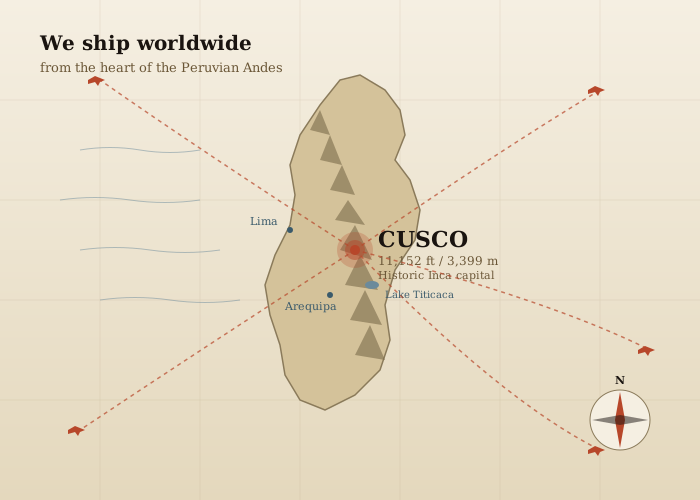
There is a reason Peruvian alpaca is the global reference — the yardstick against which fiber from every other country is measured. It is not marketing. It is a combination of geography, climate, genetics, and 6,000 years of continuous breeding in the one part of the world the animal actually comes from. This chapter is a short case for Cusco as the right place to buy alpaca, and a practical guide to how our orders reach you.
Why Peru, and why Cusco
Alpacas are domesticated animals, but they did not domesticate well everywhere. Outside their native range, fiber quality drifts — microns creep up, uniformity declines, colors fade. The reasons are partly genetic (the narrow founder stock of overseas herds) and partly environmental. The altiplano is a very specific place:
- Altitude. 3,500 to 5,000 m above sea level. The thin air selects for the efficient respiratory physiology that makes the camelid body work.
- Temperature range. Cold nights, cool days, rarely extreme heat. Fleece quality is rewarded; heat-related fiber damage is rare.
- Dry air. Low humidity produces lustrous, clean fleece with minimal felting on the animal.
- Native pasture. Ichu grass and other short, hardy Andean species are exactly what alpacas evolved to eat. No nutritional gaps.
- Continuous breeding tradition. Andean herding communities have been making selection decisions for 60 centuries.
Within Peru, the states (departamentos) of Puno, Cusco, Arequipa, and Huancavelica together hold more than 75% of the national herd. Puno is the largest producer by volume. Cusco is the historic and cultural heart of alpaca country — the former Inca capital, where the tradition of fine cumbi cloth originated, and where many of the country's best weavers, knitters, and cooperatives still work.
The terroir of alpaca fiber
Wine people talk about terroir. Alpaca has its own version. Fleece tested from animals at 4,200 m in Puno will, on average, come out finer, more uniform, and more lustrous than fleece from the same breeding lines at 1,500 m in a coastal farm. This is not an invented distinction. Every international fiber buyer who has tried to source from outside the Andean highlands learns it the hard way.
The practical upshot is that the fiber entering our catalog comes from the altitude band where the animal actually evolved. We do not buy from lowland Peruvian farms; we do not import fleece. Every skein, every yarn cone, every finished garment traces back to a specific altiplano herd.
The people who raise them
Peruvian alpaca country is mostly managed not by large industrial estates but by small family herds and rural cooperatives — Quechua-speaking communities that have been in this work since long before the Spanish arrived. A typical altiplano family might own 50 to 300 alpacas, manage them collectively with neighboring families, and sell graded fleece annually to cooperative buying centers.
This matters for two reasons. First, it means that when you buy Peruvian alpaca you are buying from an economy distributed across thousands of households rather than consolidated into a few industrial feedlots. Second, it explains why quality varies — some cooperatives are excellent, some less so, and the buyer's job is to know the difference. Our sourcing is built on direct, repeated, personal relationships with specific producer groups rather than on open-market purchase of undifferentiated fiber.
A short supply chain
Here is the end-to-end path a typical garment takes in our operation:
- Shearing. October, on the producer's farm. Fleece sorted at the shearing floor.
- Collection. November-December. Fleece moved from producer to cooperative buying center; paid by grade.
- Mill. Fiber sent to a spinning mill in Arequipa or Cusco; spun into yarn to our specifications. January-March.
- Workshop. Yarn distributed to weavers and knitters in Cusco province. Production runs 4 to 10 weeks depending on the piece.
- Finishing and inspection. Every piece hand-finished, inspected, and packed at our Cusco workshop.
- Shipping. Tracked international courier from Cusco to customer.
From sheared fleece to a finished garment in your hands is typically 6 to 14 months. The slow stages are all deliberate — there are no shortcuts that do not show up later in the garment.
How we ship
We ship worldwide by tracked international courier from Cusco. Standard transit times from dispatch:
| Destination | Typical transit | Carrier |
|---|---|---|
| United States & Canada | 5 – 8 business days | DHL / FedEx Express |
| Western Europe & UK | 6 – 10 business days | DHL / FedEx Express |
| Eastern Europe | 8 – 14 business days | DHL / FedEx Express |
| Asia-Pacific | 7 – 12 business days | DHL / FedEx Express |
| Latin America | 3 – 7 business days | Serpost / DHL |
| Middle East | 8 – 14 business days | DHL Express |
| Africa | 10 – 20 business days | DHL Express |
All shipments are insured, tracked door-to-door, and signed for on delivery. We send the tracking number at dispatch. Shipping cost is calculated by weight and destination and appears on the quote before you commit.
For wholesale and large orders we also ship by air freight (for 30+ kg shipments) and by sea freight (for very large orders, typically 200+ kg). Air freight lead times are similar to courier; sea freight is 4 to 8 weeks but significantly cheaper per piece.
Customs, duties, and returns
Import duties and local taxes are the buyer's responsibility in most countries. Alpaca garments are typically classified under HS code 6101-6117 (apparel) or 6301-6302 (home textiles), with duty rates that vary widely: 0 to 20% in most major markets, depending on trade agreements. The United States has specific preferential treatment for Peruvian textiles under the Andean trade framework. The European Union applies generally low rates on certified-origin Peruvian goods.
We provide a commercial invoice, packing list, and certificate of origin with every shipment. For large shipments we can coordinate with your customs broker directly. For small shipments most customers handle clearance via the courier's simplified process.
Returns: because most of what we ship is custom-selected by email, we work hard to get the order right the first time — asking about size, intended use, color preference, and fiber grade before shipping. That said, if a piece arrives and is genuinely not what you wanted, we will work with you on a return or exchange. We ask that return requests come within 14 days of delivery and that the piece return in unworn condition.
Getting in touch
We handle all inquiries personally by email. Write to us in English or Spanish:
Based in Cusco, Peru · Worldwide shipping · Reply within one business day
What to include in a first email
- What you are looking for (category, quantity, purpose)
- Your shipping country
- A deadline if you have one
- Any questions about fiber grade, color, or customization
A one-line "send me the catalog" also works perfectly.
Previous: Products & Textiles · Return to: Home