
Every alpaca in the world belongs to one of two breeds. They are the same species — they interbreed readily, they can produce a litter of siblings each with a different fleece type — but the appearance of the two is so different that most newcomers assume they are looking at different animals entirely. One looks like a fluffy cloud on legs. The other looks like it is wearing hundreds of silky dreadlocks. Both produce world-class fiber, but the fleece behaves differently on the animal, in the mill, and on the finished garment.
Why two breeds at all?
The short answer is that nobody knows for certain. The Suri fleece type is a dominant trait controlled by a single gene (or a small cluster), which means Suri has almost certainly existed as a variant of the alpaca for thousands of years. Some historians argue that Suri were the prestige animal of the Inca nobility — the fleece producing cloth soft and lustrous enough for royal garments — while Huacaya were the workhorse fiber producer of the general population. Whatever the origin, the Spanish conquest hit Suri populations hardest: by the twentieth century they had nearly disappeared outside a few remote herds in the Peruvian altiplano.
Today Huacayas make up approximately 94% of the global population and Suris about 6%. In absolute numbers that still means around 250,000 Suris worldwide, most of them in Peru. They are no longer endangered, but they remain rarer, more delicate, and generally more expensive than Huacayas.
The Huacaya
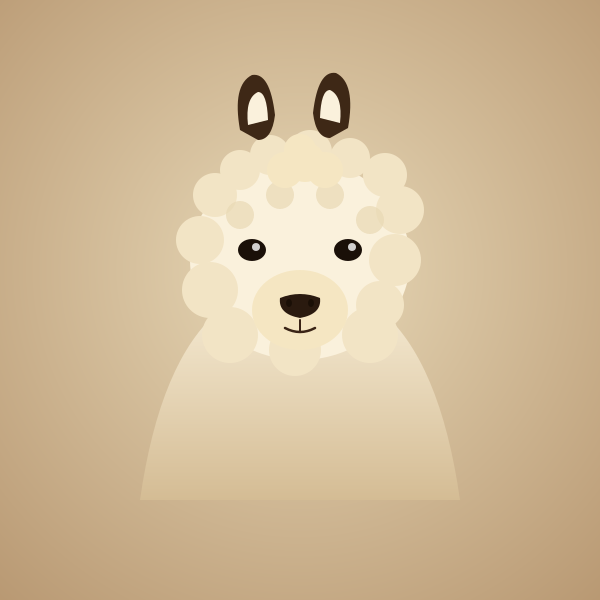
When someone closes their eyes and pictures an alpaca, they are picturing a Huacaya. The fleece grows perpendicular to the skin, bouncing outward in a tight crimp that gives the animal its unmistakable teddy-bear profile. A well-bred Huacaya in full fleece looks like a small walking cumulus cloud.
Fleece character
Huacaya fibers are crimped — they have a three-dimensional wave pattern along their length, like a corkscrew stretched slightly open. This crimp is what gives the fleece its loft (the quality of springing back after compression), its insulating power, and its ability to hold shape in a knitted garment. The fleece covers the animal densely from ears to ankles and grows roughly 8 to 15 cm per year.
Physical build
Huacayas have a compact, rounded silhouette. The neck is heavily fleeced, the head is rounded, the topknot of fleece between the ears is a signature feature, and the body appears almost perfectly spherical when the animal is in full wool. After shearing — which transforms the animal into something that looks rather like a long-necked goat — the actual body underneath is revealed to be considerably slimmer.
Temperament
There are no consistent behavioral differences between the two breeds, but breeders often report that Huacayas seem slightly more placid and easier to handle. This is probably a function of long-term selection rather than any breed-intrinsic personality.
The Suri

The Suri fleece grows parallel to the body rather than perpendicular to it. It hangs down in long, twisted, pencil-like locks that part along the animal's spine and cascade toward the ground. A Suri in full fleece looks less like a cloud and more like an animal wearing a long, glossy silk robe.
Fleece character
Suri fiber has no crimp. Instead of waviness, it offers exceptional lustre — a visible sheen caused by the smoother cuticle of each fiber reflecting light. The locks hang in uniform, well-defined ringlets when the animal is healthy, and in a young Suri the fleece has a silky, almost wet appearance. Suri fiber is sometimes described as closer to silk than to wool; it drapes rather than springs.
Physical build
Beneath the locks, a Suri is built similarly to a Huacaya, but the silhouette is dramatically different. Because the fleece hangs instead of standing out, the Suri appears more slender, with a visible "column" of locks running down the neck and a draped appearance over the back and flanks. The face is typically less fluffy; the eyes show more clearly.
Fleece vulnerability
Suri fleece is less forgiving than Huacaya fleece. The long locks are easily matted by rain, snow, or vegetation. Suris need more attentive management: better shelter during wet weather, cleaner pastures, and sometimes coats during prolonged humidity. This is one reason the breed is less common — it is simply harder to raise well outside its native climate.
Side-by-side comparison
| Feature | Huacaya | Suri |
|---|---|---|
| World population share | ~94% | ~6% |
| Fleece growth direction | Perpendicular to skin | Parallel to skin |
| Signature trait | Crimp | Lustre |
| Fiber surface | Scaled, matte | Smooth, glossy |
| Handfeel | Springy, lofty, warm | Slippery, drapey, silky |
| Typical garment use | Knitwear, hand-knits, sweaters | Wovens, linings, suiting, luxury drape |
| Annual fleece yield | 2.5–5 kg | 2.5–5 kg |
| Management difficulty | Moderate | Higher (wet-climate sensitive) |
| Price per animal | Lower baseline | Typically 1.5–3× higher |
Choosing between them
For farmers entering alpaca husbandry, the honest advice is: start with Huacayas. They are more forgiving of beginner mistakes, cheaper to acquire, easier to sell, and produce fleece that slots straight into the largest end of the market (hand-knitting yarn, knit garments, accessories). Suri is a specialist pursuit — breeders who succeed with them tend to have either dry climates, significant shelter infrastructure, or both, and a clear plan for the woven-textile market.
For buyers of finished garments, the decision comes down to what you want the fabric to do. A Huacaya sweater is warm, springy, bouncy, forgiving; it holds its shape, traps air, and feels like the classic image of a winter knit. A Suri shawl, by contrast, drapes like liquid — it's flatter, shinier, cooler to the touch, and moves with the body. Both are extraordinary. They are simply different extraordinaries.
A note on "baby alpaca"
The term "baby alpaca" in a garment label does not mean the animal was a baby. It refers to the grade of fiber — specifically fiber under roughly 22.5 microns in diameter, which most often comes from an adult animal's first or second shearing. Baby alpaca is available in both Huacaya and Suri varieties. See our fiber chapter for the full grading system.
Do they share colors?
Yes. The same 22 natural color designations apply to both breeds. You can find pure white Huacayas, pure white Suris, jet black Huacayas, jet black Suris, and every shade in between. The genetics of color are controlled by the same loci in both breeds; it is the fleece structure that differs, not its pigmentation. That said, extremely dark colors are slightly rarer in Suri populations, and very pure whites command a premium in Suri because they maximize the visual impact of the breed's signature lustre.
For more on natural color, the fiber itself, and the factors that determine price and quality, continue to the fiber chapter.
Previous: About the Alpaca · Next: Alpaca Fiber